
Each year, thousands of petitions are denied because applicants do not fully understand the basic eligibility requirements for family sponsorship—who is eligible to sponsor and who qualifies to be sponsored under USCIS regulations. Common mistakes such as misunderstanding legally recognized family relationships, miscalculating the minimum income requirement for Form I-864, or failing to monitor the monthly Visa Bulletin and priority dates have led to unfortunate consequences. First Consulting Group – a leading immigration law firm in the United States – provides guidance on distinguishing immediate relatives from family preference categories, as well as step-by-step assistance for handling complex cases such as CSPA issues, stepchildren under 18, or humanitarian petitions.
To facilitate lawful family reunification, USCIS (U.S. Citizenship and Immigration Services) has established a clear classification system for visa categories based on family relationship, citizenship status, financial requirements, and legal documentation. Understanding which family members qualify and meeting all eligibility criteria are key factors in determining the success of your petition.
For more information: Detailed Guide to Sponsoring Parents to the United States from First Consulting Group

U.S. immigration law divides family-based immigration into two main groups: Immediate Relatives – not subject to annual visa limits, and Family Preference categories – subject to annual numerical caps.
Immediate Relatives Eligible for Sponsorship Include:
Family Preference Categories:
The petitioner must meet four basic criteria. First, be a U.S. citizen or lawful permanent resident (green card holder). Second, demonstrate income at least 125% of the Federal Poverty Guidelines by submitting Form I-864 (Affidavit of Support). Third, provide proof of a qualifying legal relationship, such as a marriage certificate or birth certificate. Finally, maintain a clean immigration history and lawful status where required.
The minimum income requirement for Form I-864 in 2025 for a household of two is $26,437 per year. If income is insufficient, the petitioner may supplement with qualifying assets or obtain a joint sponsor. Failure to meet financial requirements is one of the leading causes of petition denials.
In addition to these requirements, some cases may require additional forms, such as an application for Adjustment of Status if filing within the United States, or an immigrant visa application abroad. Civil documents such as birth certificates, marriage certificates, and police clearances must be properly translated and certified to avoid Requests for Evidence (RFEs) and processing delays.

Our office has identified nine of the most common reasons a petition may receive a Request for Evidence (RFE) or even be denied:
These situations often result in RFEs or immediate denials. In particular, suspicion of marriage fraud can lead to severe consequences, including permanent inadmissibility to the United States. To minimize such risks, it is advisable to work with an experienced immigration attorney or qualified immigration service provider from the preparation stage to develop an appropriate strategy and address potential legal issues before the case proceeds to the interview stage.
When receiving an RFE or a notice indicating possible denial, First Consulting Group recommends responding within the deadline and submitting strong, relevant evidence. Some denied cases may be eligible for a motion to reopen or reconsider. If the case is placed under administrative processing, applicants may be asked to submit additional documentation or wait for further verification by immigration authorities.

CSPA (Child Status Protection Act) helps “freeze” a child’s age if they age out while waiting.
Formula: Current age – I-130 pending time = CSPA age.
If the result is under 21 years old, the child may still qualify for U.S. immigrant sponsorship.
A stepchild under 18 years old may qualify if the parent married before the child turned 18. Proof of a legal parent-child relationship and a valid marriage certificate is required. Estimated fees include: I-130 (Online filing: $625; Paper filing: $675), immigrant visa fee ($325), medical exam ($210–$389 depending on age), and vaccinations ($150 per person).
An adopted child may qualify if the adoption was completed before age 16 and the child has lived with the adoptive parents for at least 2 years. First Consulting Group recommends preparing complete adoption documentation as required.
Individuals who are currently in the U.S. may apply for Adjustment of Status instead of applying for an immigrant visa at a U.S. consulate, which may shorten processing time and reduce the risk of denial at the interview stage.
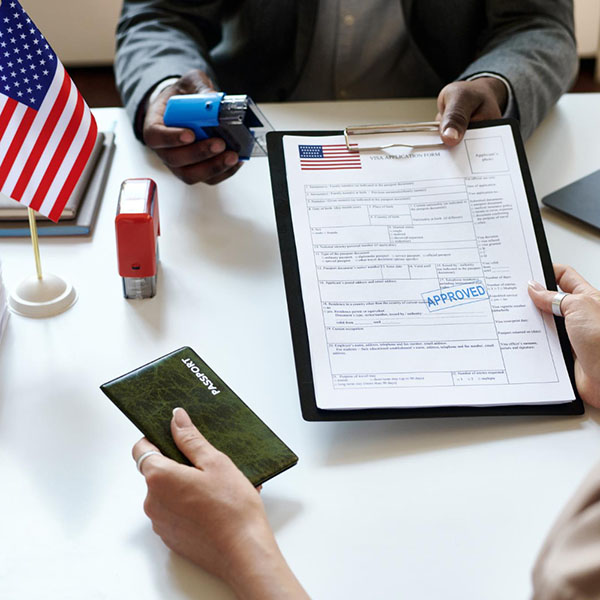
Humanitarian reinstatement applies when the petitioner passes away after filing Form I-130. The family may request USCIS to reopen the petition on humanitarian grounds if they can prove that a qualifying relative would face extreme hardship if the beneficiary is not allowed to immigrate to the United States.
Form I-601 and I-601A waivers apply to cases involving inadmissibility due to unlawful presence or illegal entry. When filing, the applicant must clearly demonstrate that a qualifying relative (depending on the case, this may be a spouse, parent, or child who is a U.S. citizen or lawful permanent resident) would suffer extreme hardship if the petition is not approved — rather than simply presenting the applicant’s personal circumstances.
Cases involving inadmissibility may still be considered for a waiver through I-601 or I-601A, provided all legal criteria under immigration policy are met. This process requires in-depth knowledge of immigration law, particularly the ability to analyze and present the factor of “extreme hardship”, as well as experience handling complex immigration cases.
To prepare more thoroughly, applicants may review additional topics such as how to prepare a family sponsorship petition package, the consular interview process, guidance on calculating age under the Child Status Protection Act (CSPA), or monitoring the monthly Visa Bulletin. Taking a step-by-step approach helps reduce errors and increase the likelihood of approval from the beginning.
Understanding the correct eligibility requirements for sponsoring family members to the U.S. helps improve approval rates. Properly distinguishing the right type of petition documents and preference categories can shorten processing time. From identifying the correct family-based petition category to tracking the visa bulletin and priority dates — every detail affects the final outcome.
In particular, sponsoring a family member to the U.S. for employment or study purposes involves different requirements compared to sponsoring a family member for permanent immigration. Each family sponsorship petition must be individually evaluated to determine the most appropriate strategy.
If you need additional information or legal consultation regarding immigration cases, family sponsorship, or complex immigration procedures, please contact First Consulting Group for dedicated guidance and professional support. Connect with our team for personalized consultation and assistance throughout your immigration journey.
FOR A FREE CONSULTATION, PLEASE CALL:
– Garden Grove Office: (877) 348-7869
– San Jose Office: (408) 998-5555
– Houston Office: (832) 353-3535
– Vietnam Office: (028) 3516-2118
The U.S. immigration process can be intricate, involving detailed legal requirements and procedures. To better address your unique situation, please provide your contact details to arrange a personalized consultation. A member of First Consulting Group’s dedicated team will contact you during business hours to offer expert guidance.

USA
12966 Euclid St., Suite 520, Garden Grove, CA 92840
(714) 638-3111
USA
989 Story Rd., Suite 8075, San Jose, CA 95122
(408) 998-5555
USA
1880 S Dairy Ashford Rd Ste 539, Houston, TX 77077
(832) 353-3535
VIETNAM
8th Floor, Tuoi Tre Tower, 60A Hoang Van Thu St., Duc Nhuan Ward, Sai Gon
(028) 3516-2118
VIETNAM
5th Floor, Bao Minh Building, 08 Phan Van Tri St., Ninh Kieu Ward, Can Tho City
(0292) 383-0001
VIETNAM
5th Floor, Viettel Building, 11 Ly Thuong Kiet St., Thuan Hoa Ward, Hue City
(0234) 381-0016
VIETNAM
6th Floor, ACB Building, 218 Bach Dang St., Hai Chau Ward, Da Nang City
0886 00 34 00